Creative writing from the classroom and beyond. Home of The Word Pool Method — a simple, powerful way to spark stories using unexpected word pairings. ✍️ Each week: new prompts, short pieces, and writing challenges.
Thank you to Miles Rogoish (www.mrface.art and/or IG: @milesrogoish) for the beautiful artwork for the book! “Shifting Identity” was the perfect art prompt for Miles. He recently discovered an appreciation for coffee, and this piece depicts that … his identity shifting!
The new edition on Amazon includes more artwork and short stories all drawn from the prompts in this book.
Our son, Joey, wrote a piece with the prompt, “Agonizing System.” It blew my mind!
A current student wrote a horror piece using “Campbell’s Mode” as an assignment in Comp I. I enjoyed it so much, I asked her if I could include it in the book!
There are millions of prompt possibilities in this book! And, there’s excellent information on continuous writing for those who claim writer’s block from time to time … and for those who don’t.
I’m pleased with this project, and I use it myself.
“The Word Pool” has MILLIONS of Writing and Sketching Prompts. Don’t Believe Me? Read This. Today’s Prompt? OPPOSITE STUDENT DIFFERENTIATES. WTH?!?! Right? Nope. My Brain Had This.
Inside this book is a creative system disguised as a game—built from over 5 million word pairings designed to spark unexpected connections, challenge your thinking, and unlock your creativity. Whether you’re a writer staring at a blank page, an artist unsure what to draw, or someone who “just isn’t creative,” this book gives you something most people are missing: A way to start.
Using simple but powerful techniques like Continuous Writing (Dr. Price’s “Rule of Apple”), associative thinking, and structured challenges like Campbell’s Mode, you’ll learn how to:
generate ideas on demand
push past creative blocks
connect unlikely concepts into stories, characters, and visual scenes
build confidence in your creative voice
This isn’t just a writing book. It’s a tool for teachers, students, writers, artists, and creators of all kinds.
Open the book.
Pick two words. Or three.
Write it. Sketch it.
Let’s go.
Here’s an example of exactly how to use “The Word Pool.”
Randomly, I’ve chosen “Student,” “Opposite,” and “Differentiate.” Now, a verb isn’t always necessary. Most of the time, I begin with simply an adjective and a noun. Recently, I had my Comp I students write a short story with 4 out of 6 adjective/noun combos from “The Word Pool.” Their combos were: Noxious Room, Incessant Secret, Fortunate Painting, Faux Email, Disloyal Blood, and Approaching Lantern. They chose 4 of these 6, which I had randomly chosen from “The Word Pool.” Their stories were AMAZING, verging on King-worthy creepy horror stories! I was thrilled to say the least, and enjoyed reading each one of them. Those students didn’t have those stories in their heads BEFORE the word combinations came their way … the word combinations sparked the ideas! This book gives birth and gives life to creativity! So, let’s get back to … “Opposite Student Differentiate!”
I’m going to set a timer for 10 minutes and see where my mind goes. I have no plan. Literally, I opened the book a bit ago, chose words at random by looking away as I flipped pages, pointing to a spot on the page at random, and then looking at where I landed. So, here we go.
The light came in through the window as she sat staring off into the distance. To an outsider, it looked as if she were pondering which book to pull off the grand bookshelf, but that’s not what reality was in that moment. She hurt inside. She didn’t think she could pull it off, and everyone kept telling her she’d be fine; she could do it. But, she knew she couldn’t. She knew that she’d fail. She knew she was the opposite of what a student ought to be. She didn’t want to acquiesce to anyone else’s way of doing the things before her. She liked to live by the seat of her pants, be carefree, but they wanted to put her in a box … and she let them. Traveling. Disappearing. Hiking. Exploring. Go. Go. Go. That is what she wanted. She wanted to learn from life – meet people in strange places, delve into their cultures, experience humanity and landscapes, and all the beautiful things. But no, here she was in the great library, surrounded by books, the light from the outside pouring in through the window taunting her, telling her all that she was missing out on by being stuck in that space.
Learn all the things – learn the business.
It will be yours soon.
You have to study.
That’s what her grandfather said. He wanted to leave it all to her, and she didn’t want it. The whole family said their future rested on her shoulders, and she wanted to burst out of her skin. They all saw no other future for her, but she sat there knowing that she, the opposite student, differentiated between freedom and a state of giving up – and in that moment, as she sat staring at the bookshelf, lost in thought, looking like she was doing as expected, the escape plan began to shape in her mind. She had to leave, run, fly. Anywhere but here. They’d figure out how to pick up the pieces without her. She needed the sand between her toes, eagles soaring high above her, snowflakes hitting her face – so many wonderful places and so little time, and she would not waste a moment. No. Not me, she thought. I will be free.
“Mary Ann, your grandfather wants a word.” The voice snapped her out of her plan.
She looked toward the voice, and there stood her grandfather’s solicitor in his crisp three-piece suit. It was black, and it made him look like a funeral home director. For her, that’s what he felt like, and she simply nodded understanding. She looked out the window where her freedom lay, just briefly. She sighed, then looked at the solicitor’s unsmiling face. Quietly, she followed him out of her grandfather’s grand library and down the hall to the dining room, where she knew, at this time of day, her grandfather was having his fifth cup of coffee …
I don’t know Mary Ann, and I don’t know why she doesn’t want to run the family business, and I certainly do not know where that’s coming from inside me. We could have a psychology session, I suppose, and sit and dissect how Mary Ann represents a part of my psyche, and that could be fun, but that’s not the point. The point is, without the prompt “Opposite Student Differentiate,” that story would never have surfaced from my mind.
Sometimes my posts are non-fiction. Once I choose my word pairing, I sit down, open the laptop, and words just start spilling. If I “get stuck,” I employ my friend Doug’s continuous writing method (which is discussed in “The Word Pool” book) … apple, apple, apple, I just got a text from my son. He said something about eating breakfast. Wish I could be eating it with him. I hate the distance between us. And then, when I’m ready to get back on task … get back on task. Words can be edited. Rearranged. Changed. Just keep writing. Beautiful things come when we stop trying to control them.
Ah … that’s a lesson for life, too, is it not? Beautiful things come when we stop trying to control them. That’s bumper sticker stuff!
Long story short here … use “The Word Pool” to spark your creativity. It’s fun, and you never know where it will take you! Every time you sit down to write, something NEW happens. Or when you need an idea to draw … it’s in this book.
My student, Izabel Baker, permitted me to share the short story she wrote for Comp I. The assignment was to take 4 of the 6 “The Word Pool” word pairings and freewrite – let the words take you wherever they want. Those pairings again were: Noxious Room, Incessant Secret, Fortunate Painting, Faux Email, Disloyal Blood, and Approaching Lantern. Here is Izabel’s story. See if you can find the word pairings.
Why? Why did I pick up the phone? Why did I listen? Why did I come here? Why? Why, after all these years, these long ten years, why?
Every morning, all the same, I awoke, I made breakfast, the phone rang, all the same. I ignored it, all the same, like every morning. It would pass, the tone would end, and it would be gone. I went on with my day. I got dressed, got my shoes, and got my keys. Then, unlike every other morning, the phone rang again.
That was wrong. It never rings twice; it only rings once. It couldn’t ring twice, no, no. There was no one to call twice; they were gone by this time. Every morning, they made the phone call and shortly after were gone forever. How could they call again? But all the same, I ignored it, as I should. Answering would be a grave mistake, grave indeed.
I left, left the house, left the phone behind, there, couldn’t answer it now. It couldn’t reach me now. I’ve moved one, moved one from that, left it behind me, gone forever—no point in answering.
Then I returned home, the phone was ringing when I arrived, and it rang all night; it didn’t stop. Finally, I couldn’t take it, that droning noise, piercing my skull, rattling my bones. I made a grave mistake, I picked up the phone, and I answered it.
“Sadie, are you coming home? We found your bed empty this morning. Mom’s really worried about you. We all are. I- I really need you, Sadie. Please, your little sister really wants you to come home. Please, Dad’s really mad, Mom’s just crying in the kitchen. Sadie, please come home.”
She sounded so real, so alive, so vivid, so visceral. I couldn’t. The sound of her voice chilled me, froze me. So why? Why did I listen? Why did I return?
The house emerged from the ground, surrounded by open fields. There were a few cows out there, what few could survive without human aid on just the grass that grew. I stared at it for a long time; that thing loomed over the road. Why didn’t I turn back then? All I would’ve had to do was turn the key and drive away, but something pulled on me.
Then I saw it and saw her. A young girl standing on the porch, holding a lantern, a small, dim lantern close to her chest. She was almost hiding it from me, like she didn’t want me to take it. It wasn’t Tammy, no, Tammy was only twelve years old; that girl was much taller, older, something about her felt a little familiar, though.
I got out of my car, and she turned into the house, but she left the door open. It was dark inside, and I could barely see in. I couldn’t decide how I felt. I felt repulsed, my mind told me to run, to leave, but deep inside of me, I felt compelled to enter. Maybe that’s what they call a soul; maybe it was calling for me inside. Left behind when I left here ten years ago. Now that I think about it, it was exactly ten years ago that I got the first phone call.
Every day for ten years, the phone rang every morning at 7:34, every morning since.
I took one step inside, then another, then another, then another, then the door slammed behind me. When I turned to open it, it was locked. I couldn’t leave. I never should have come in here. Why, why don’t I listen to my gut?
Then there she was again, past the foyer, at the end of the long hallway, that girl, but she was closer than before now, and her lantern was held so tightly; she held it just in front of her chest. I went down the hall toward her; dust floated in the air, the wallpaper was peeling, the floorboards creaked, bugs crawled this way and that. The water and termite damage had gone long untreated, ten years untreated.
When I looked up, she was gone, but to my left, there was a door. A faint light came from within; I turned inside. The study. I never came in here. Dad would yell if I ever did, but yelling was all he ever did. A lamp flickered in the corner, the books on the shelves were sloppily thrown in, and the old computer was covered in dust. I doubt the keyboard even worked, not that I cared to see what he had been doing on it, just when he was on it. He was occupied then, in his own room of the house, for just a few moments, I could forget about him.
On the wall, there was a painting. What a fortunate painting it was. All of us, mom, dad, me, and my little sister, all smiling. It didn’t see the real us; it saw the nicely kept home, not the stains and messes. It saw a happy family, not the horrors left by our father. It saw an able-bodied woman, not a mother whose health declined further every day.
Tammy, you bright little girl, you had the biggest smile. I like to believe a little bit of it was real. You were always so positive. I did my best to keep you safe so that you could keep smiling. I’m sorry I left, I’m sorry, you probably didn’t smile again, did you?
There she was again, that girl with the lantern; she was standing in the doorway, holding the lantern a little closer to me. She turned away down the hall, but when I got there, she was gone again. There wasn’t a faint light this time; it was darker than before.
There wasn’t any direction; I just wandered for a bit, turning through the halls. The home was larger than I remembered. There was a stairwell; the boards had been chewed through in some places, probably termites, possibly mice. The railing had fallen out in some places and was left in pieces on the floor below. I found myself ascending the stairs, up to the top, then down to the right, a room with an open window; the wind blew the curtain around.
This was Mother’s room.
This was where she looked out, her only window into the outside world. She used to knit blankets, clothes, and tablecloths. Then her health declined; she stopped smiling, stopped knitting, barely moved, only to cook and clean when she could, when the pain wasn’t too much. But it usually was, so I did.
The room hadn’t changed, except for the condition of it; like the rest of the house, the wood was damaged, but even more so up here. I didn’t trust the floorboards; I shouldn’t have. I made my way downstairs, then… the floor gave in.
My heart lurched for a moment; it felt like a moment in a cartoon where the character is suspended in the air for a moment before falling to the ground. But just like in the cartoons, I eventually fell. Unlike in the cartoons, I wasn’t fine and revived after. My breath left me; maybe it was my lungs that had been suspended in the air, not me.
I couldn’t breathe, couldn’t even scream.
I had fallen through the floor onto the dining table, which cracked in two. It felt like my back had done the same, but I managed to get up. A part of me wished I couldn’t so I could lay there and die, but something called for me, not a voice but a feeling. She was closer than ever before, that girl, her lantern stretched out towards me, almost a full arm’s length. For the first time, her mouth moved, and she spoke, “Remember, remember what you did. Those splats of blood, that disloyal blood. Remember why you left, why you abandoned everyone.”
I looked beside me. There were drops of blood on the table where I had fallen, bits of wood had scratched into my skin, leaving gashes. I tried to wipe it away, but it smeared across my arm. I burned everywhere: the bruising on my back, the cuts on my sides, but I had to keep moving.
I felt bits of resentment towards that girl with the lantern, forcing me to come here, forcing me to feel this pain, forcing me to relive this place, forcing me to remember.
I felt tears come up; they came through gasps of pain and gasps for air. I struggled to move forward on the other side of the door, leading out of the dining room was the kitchen. I went to the wall and slid down it. I didn’t need to know what was on the other side; I could smell it, that thick, pungent odor of blood. There must have been so much on the other side; the wounds must have gone deep. They must have been in so much pain. It was my fault, wasn’t it? If I hadn’t left, I would have stayed. If I had come home sooner, maybe then.
I almost began to sob, but the shaking of my body was so excruciating that I clenched my throat in an attempt to stop it. That noxious room on the other side felt like it was growing larger, more powerful, more gruesome. The longer I waited here by the door, the stronger the smell grew; I heard dripping.
Blood dripping, drop by drop by drop, onto the tile.
I knew I needed to turn the corner. One inch at a time, then another, then another, I peered around the door. I never should have, never should have picked up the phone, never should have listened, never should have come here, never, never. Never should have turned that corner. I never should have left, never should have left Tammy behind. I should have taken her with me, should have gotten help, and done something. But no, no, I left by myself, escaped, I used to say, but no. I didn’t escape this place; I abandoned my sister, my little sister. It was my responsibility to keep her safe, to protect her. I hated my mom, my mom never protected me, never kept me safe, why then, should I for another? Why? Why did I let my resentment for her allow Tammy to get hurt?
She was there, right on the floor. She must have run to the door, tried to escape, but bullets are much faster. Blood soiled her clothes, spilled around her in a pool on the ground. I started to tremble, felt like screaming, felt like running, but I couldn’t. I was frozen, stuck staring at the scene.
Mom lay on the ground, shot straight through the stomach. My eyes followed her to a large metal pot in front of her, to a pair of large boots, and up to a man. I knew who it was, but if I were a stranger coming across the scene, he would have been unidentifiable. His face was gone; the skin seemingly melted off in a spot where his left eye should have been. Large blisters swelled around the area across his neck and arm down to his hand, where a gun still lay. Oil and blood dripped from his face onto the cold tile.
What happened first? Did mom attack him, and then he shot her? Did he shoot Tammy, and Mom throw the pot at him? How? How could something like this happen? Why? If I had stayed, was there something I could have done?
“No point.”
I turned around, there she was again, right behind me, holding her lantern, but still far away enough that I couldn’t quite make out her features.
“No point in asking questions, you know what must be done. Now go, do it.”
She didn’t sound sympathetic; I wouldn’t either. Who else was there to blame myself? But I knew what she meant. I knew what must be done. I went to the back door and found it unlocked. I dug three holes, took what felt like hours, but the sun wasn’t even considering rising yet. I went inside the house, for a moment I considered leaving my father there, but in the end decided he ought to be placed in the ground anyway, it wouldn’t be fair for my mother and Tammy to be laid below our father.
I couldn’t fashion a true gravestone, not now at least, but I found old scrap wood and a knife from the kitchen and scratched into it plates for my mother and Tammy. “Here Lies Tamala R. Julias. May 2, 2004 – April 10, 2016. Rest in peace, Bright Child.”
I didn’t make one for my father; he ought to be buried, not honored or respected.
I stood, my work was done, and I saw an approaching lantern. The girl came all the way to me. This time, she was close enough for me to make out her features, my own features. She was fifteen years old, with a bruise on her arm, sullen cheeks, and so much shame.
Maybe, maybe I ought to forgive myself, or rather, forgive her.
She was only fifteen, I was only fifteen then, the past is behind me. I can only move forward. That old version of myself, a ghost, a memory, whatever the vision was in front of me, handed me the lantern. It felt nice, expelling some sphere of warmth around it. I looked at fifteen-year-old-me, “You poor thing, please, please move on, I forgive you.”
With that, a smile, albeit a painful one, stretched across her cheeks, and she faded away. I was alone now, but then again, I had been alone for many, many years.
Tammy would forever be gone, but I found a new part of myself.
Life wasn’t over, mine wasn’t. Tammy would probably tell me I should keep on living.
I found a picture of Tammy, Mom, and me, one of the few that was just the three of us. I decided to keep it; every night on my bedside table, I told them goodnight, and maybe beyond the veil, if there is one, they said it back.
Dacia Lené Cunningham is an Assistant Professor of English at Tulsa Community College, where she blends creative writing with real-world communication in courses ranging from Novel Writing to Composition.
She is the author of novels, short stories, and children’s books, including A Kiss in the Rain and The American Queen, and she founded the TCC Writers’ Series to bring authors and publishing professionals directly to her students. https://guides.library.tulsacc.edu/TCCwritersseries
She believes anyone can write—you just need the right tools.
Alice LaPlante – “The Making of a Story” – p. 130 – “Render a Tree, Capture the Forest.” Part 2. Exercise 2.
Using 12 details, describe a place. I chose my hometown. And … well, in true Dacia style, I used far more than 12 details for you. The piece I used as an example for class did not expand to quite this length. Once you start describing a place, details tend to crop up … and let me tell you, I have far more in my head and heart than are contained here. McAlester people, how’d I do describing our hometown?
When the bombs go off at the Ammunition Plant, you feel it through your bones, and even though it has happened your entire life, it still raises the hairs on your arms. The Ammunition Plant is on the southernmost end of town, and I didn’t go to that side of town often. I was a north-side kid.
There are only 18,000 people in McAlester, Oklahoma – the same population as it had when I was a teenager there in the late 1980s. The town is large enough for you to stay in your own area, your own zone, where your people are for the most part. As a north-side kid, I grew up on the north side of town, a block from the city limit, which was just on the other side of that last street in town, which is aptly named North Street. St. Joseph’s Catholic Cemetery was on North Street, a block from the rock house I grew up in at 602 E. Ashland Avenue. You could see the cemetery from my front yard, and that is where my two lifelong best friends, Lana and Jackie, and I played as children. The gravestones in there were ancient, dating back to the early 1800s, and in my head, I made up stories about the people buried there – especially the mass grave dedicated to Italian coal miners who lost their lives in 1892 in an explosion in the hills and ‘mountains’ of Southeastern Oklahoma. Lana, Jackie, and I rode our bikes around and around and around that cemetery. Played hide-and-seek. Climbed on Jesus. Popped wheelies out of ditches.
My favorite restaurant, where I grew up, is in Krebs, Oklahoma, just outside the McAlester line, where Krebs butts up against it like a suburb. Krebs is an old Italian settlement, and the family-owned and operated restaurants I grew up eating in are still there. You can go to Pete’s Place; that’s whatever. It’s the most popular … but just a bit further down the road sits Roseanna’s Italian Food, and that is where my car goes whenever I get the opportunity. Home-style and home-style-served Italian dishes with giant meatballs, tangy salad, and pasta that will cause you to kiss your fingers like an old Italian grandmother. Mwah! After that, going to Lovera’s Market in Krebs is a must – home-raised meat, homemade Italian sauces. Or don’t go. Leave that food there for those of us raised on it, who appreciate the treasure existing there just outside of the McAlester city line.
McAlester is the town of Monroe in my book “A Kiss in the Rain.” Those who’ve read it and grown up in McAlester like me knew their town as they read of landmarks, stores, and roads in the pages of that novel – a grocery store in the middle of town which used to be “Safeway,” the old Busby Theater (which is gone now), the Courthouse, which once was a grand hotel in its hay day – tunnels ran underneath it to the theater, the prison – OSP – we are all so proud, the grand yellow home at the corner of 2nd and Miami that once belonged to friend of my parents. Tandy town. Highway 69, which curves around the eastern side of the town, separates McAlester and Krebs. Walmart, which only locals know how to get to because of someone’s idea of improvement to the highway structure there. The church I grew up in – Lakewood – sits on the most curved part of Highway 69 as it rounds from the eastern side of the town to the southern portion of town. The movie theater is still there, holding memories – some I’ll discuss, some I won’t. The high school. The signs on every road leading out of town that say, “Warning: Hitchhikers may be escaping convicts.” I’ve always read “escaping” as an adjective until recently, when my husband read “escaping” as a verb … and now, I can’t take those signs seriously.
McAlester is where I was born and where I’m from. It gave me my best friends, and a host of other people from school and church alike that I hold dear in my heart. McAlester is the town that raised me, and there’s much more I could say about it, but for now (to my students), knowing I grew up playing in a cemetery and eating fine Italian food is what you get to know. Another little layer pulled back on the onion of who Mrs. C. is.
The Word Pool” is a beautifully written book devoted to writers who love to play with language. The idea of pairing unrelated adjectives and nouns together to impregnate them with new meaning makes for unforgettable writing, Thomas Paine wrote about the “summer soldier and the sunshine patriot.” His purpose was to steel the resolve of the American Army in the face of overwhelming British military power. His use of words was unforgettable, inspiring Americans for 250 years.
“The Word Pool” gives writers the tool to match unlikely words together to create new meaning. Complete with exercises and examples, this work is pure genius. It is a “must have” for every writer’s library.
New review of my creative writing prompt book, “The Word Pool,” from Forest Issac Jones, author of ‘Good Trouble: The Selma, Alabama and Derry, Northern Ireland Connection 1963-1972.’
“Students of writing and writers overall will love this book, and ‘The Word Pool’ will be widely recommended by teachers of writing. It is a true example of what a creative writing tool kit should be. The authors leave you with tidbits that will spark ideas and great examples of writing prompts. This book is full of little things that will help writing students. There are great parts in the book that give lists of nouns, adjectives, verbs, and writers are shown phrases and best pairings to use. It is a useful book for any writer or student of writing, and it shows the author’s sincere love of language and writing. Highly recommended.” – Forest Issac Jones, Ed. D., Author of ‘Good Trouble: The Selma, Alabama and Derry, Northern Ireland Connection 1963-1972’ – forestissacjones.com
Thank you to Dr. Jones for his review!
And, y’all, I’m telling you – this book is fun. I use it – and I wrote it/put it together – and I find it useful! There are so many possibilities. Each Saturday, I’m committed to opening the book with the specific intent of using it here in this space – to show you how it works!
Over the last few weeks, I have opened the adjective and noun pages and find myself using these combinations:
Some of them have caused me to write fiction. Some non-fiction. I just let the words roll out without a plan one in my head.
Tomorrow is Saturday, so we shall see what combination comes! I’m excited!
If you find yourself with a copy of “The Word Pool,” I’d love to hear your thoughts, see what you end up writing or drawing … perhaps I can add your drawing to the next edition of the book!
I can’t. I just can’t with this raising of one’s pitch at the end of sentences; this is called uptalk, and it makes every sentence that comes out of the uptalker’s mouth sound like a question and like the speaker is insecure. It’s like a plague in our society, and I hear it everywhere – mostly in young women in their 30s and younger. The ending of sentence after sentence with a rise in pitch makes the speaker sound unreliable, at best, and insecure, at worst, and I don’t understand how it goes unchecked.
There is a television commercial for Jacuzzi Bath starring Christina of HGTV, and her voice grates on my every last nerve. There is a rise to her pitch at the end of every sentence, and I can assure Jacuzzi Bath that Christina is not their best salesperson – in fact, she probably drives away customers as she sounds unsure, faddish, and well, ridiculous. I show that commercial to my students when we discuss non-verbal arguments.
38% of communication is tone of voice. 38%, people.
Last summer, I took a course through a company I will not name, and the speaker in one of the course videos spoke in uptalk throughout the entire lesson. I could not focus. She was in her 30s, and I’m in my 50s. I’m sure that makes a difference here; however, at the end of the course, we participated in a discussion thread about the materials the woman discussed. I chose to be honest about my inability to focus on the content because of the distracting uptalk, which made the woman sound inefficient, not to mention inexperienced, to lead a course.
Another participant in the discussion thread wrote, “Thank you for saying it!” in response to my direct comment regarding the speaker’s pitch. Others joined in agreement, and it is my hope that the facilitators of the online course will rethink the tone of that content’s delivery, which fell on an audience that values confidence in a speaker’s tone – we were all college-level educators for heaven’s sake.
Just two days ago, I went to a literary launch party … and there it was in a speaker … uptalk. It deeply concerns me that we are somehow teaching younger generations to speak this way. Is it TikTok? Where is it coming from? I don’t use TikTok, so I have no idea. To hear that uptalk at that event from someone who should know better… shocking.
There’s another part of me that wants to refrain from saying anything, say, ‘You do you, Boo,’ and let those who speak with uptalk have at their faddish tones of voice, which make them sound, dare I go ahead and say it? It makes them sound inept, so let’s let them; see, that offers more opportunities to those of us who understand that ending sentences on a lower tone conveys confidence and reliability. So, perhaps … let’s not tell them. But then again, I don’t want to have to continue to listen to it – it hurts my ears and my soul.
In our week discussing nonverbal argument in Comp II (That’s 2, not 11), please know I discuss tone of voice with my students – and I use a variety of sources that are not just me with my Gen X disdain for uptalk, one is Tony Robbins, and another is Vinh Giang (https://youtube.com/shorts/LpGIRhSZ3Jw?si=YC8N6Dp6a3a_aHHA). Each of these, along with other sources – like the Jacuzzi Bath commercial as evidence of what not to do, conveys the importance of tone – your pitch, your pace, your volume, and your timbre. The ability to control and use these in argument is rhetoric in its deepest sense, because 93% of communication is nonverbal (38% tone and 55% body language). My hope is that my students, especially the young women in my classes, grasp the dire necessity of focusing on more than just the words that come out of their mouths or appear on the pages of documents. HOW they are said matters more than what is said. Always.
Rant over. It was on my mind after the event I attended recently, so I needed to speak about it. And I also want to say, as a woman in her 50s who gets this, I am beyond grateful as a mother that neither of my daughters speaks in uptalk – get it, girls! I did something right.
Naughty Skill … Naughty Skillet. Today’s “The Word Pool” Prompt. May 2, 2026.
One of these is safer than the other to write about, but as I do not want to be a cheater, I must go with the one my finger landed on first. I opened “The Word Pool” this morning, and I chose my adjective first. “Naughty.” Then, I opened the noun section, and my finger landed on “Skill,” and my immediate reaction was a, to be honest, naughty little smirk on my own face because I know exactly what that is for me, so I tried to tell myself no one would know if I went with “Skillet” instead. A naughty skillet could easily lead into a short fiction piece about some delightful dessert cooking on the stove, something chocolate with nuts and marshmallows simmering, and who doesn’t like that – pour it into a graham cracker crust after it cools a bit, stick that in the refrigerator, and top it with cool whip later … see that wasn’t your fault, it was that naughty skillet who concocted such a caloric masterpiece. See? I can do naughty skillet. Toss in a couple of characters – Bill and Jane. It’s date night, and Jane is cooking for Bill for the first time. At her place … see that could go so many directions. But that is not what I drew to write about this morning … Naughty Skill is where we are, and to be a good example for how to use “The Word Pool,” Naughty Skill is what we shall write about … well, not “we” … me, that’s what I will write about.
Early in life, I learned that being in good standing with teachers worked to my advantage. I am a high-skill brown-noser, and I make no apology about this. It’s not that it’s a reprehensible ability; in fact, it is rhetoric at its finest – to recognize that how you read people, how you treat people, and how you talk to them, all combine into how you get what you want and need. Logos, pathos, and ethos, baby. These came naturally to me early in life, though I didn’t have a name for any of it – other than I knew how to keep people liking me (except one or two down the line of life) – and I knew how to survive.
What I mean by survive is that I knew how to stay afloat, keep good grades, avoid conflict, live in as much peace as possible on the outside, no matter the cost to my internal self. See, no one saw that. That was mine only. My hidden self. I kept it tucked away, and I listened, I spoke with intentionality, and I gained favor with people.
It could be said that I am, and have been, persuasive for most of my life. That is the euphemism for the real situation. “Persuasive” is such a nice word. It’s quite lovely. Let us use the cuss word, though. Manipulative. That suits in a deeper fashion. I teach my students rhetoric – and it’s one of my favorite subjects – a skill I love to pass on. I tell them that Argument skill is all about persuasion, if we want to sound nice about it, but truly, at its core, it is manipulative – how do we get what we want and need?
Honesty says I must divulge how this translates into a naughty skill. Throughout high school and my first bachelor’s degree, I used these abilities to read people and get what I wanted and needed in the arena of flirtation. For a number of years, I was on the hunt to secure just the right ‘husband’ – and I flirted maliciously – wow, that sounds terrible now that I wrote it, but we are going for honesty here, and that was the first instinctive word. So, it remains. No editing that out. (A little lesson here – go with the first word – it’s most often the right word). I counted it once, and perhaps, to my shame, but also, admittedly, it was a lot of fun, I kissed 42 boys between high school and through the 4 ½ years I was in college in the early 1990s. Yes, 42 … still a virgin, though, when I married in 1995. How? I have no idea. But I sure was manipulative and could “get what I wanted” – though, sadly, what I didn’t realize was that I had developed a reputation in the dorm … I wasn’t the girl they would marry. I was the girl who was fun on the weekend, quick to kiss and make out. See, I was looking through physical means to snag a ‘husband,’ and those same boys were looking to snag a ‘wife,’ and my behavior at the time was not wife material. Ah, life. The irony of it. But hasn’t it been that way for all of time? It’s okay for the men, but not the women … Oh my, did I say that out loud?
Along the way, I have learned to temper and utilize my rhetorical skills no longer as a naughty skill but as a resourceful and intentional one – helping others to learn how to understand the power of rhetoric, and how to use it for good instead of bad. I’m sure somewhere in my 16 years of teaching rhetoric in the classrooms of colleges and universities, I have given a criminal mastermind the key to unlock his or her ability to manipulate for not the best reasons, but that is never my goal. No longer a naughty skill … it is survival in the best ways. It is how I maintain and nurture good, strong, and healthy relationships. Ones that move me forward in this life, not ones that hold me down or drag me under.
I watch. I listen. I gather information. I keep mental files. And I use this information as needed to craft and determine how to speak and move as I navigate my life and career. I’m grateful to be someone for whom the use of rhetoric comes naturally. I think I’d hate to have to learn all of this from scratch. Somehow, it’s naturally inside. Awesomesauce … for me. Maybe that’s naughty to say.
I don’t think so. I think it’s realistic. I am realistic about who I am and how I function. The last few years have taught me that honesty, directness, rhetoric, and silence are keys to effective communication skills, and I am honored to teach Comp II each semester – an argument-based course, where I get to pass along all that I’ve learned on my own bumpy journey – hoping to give students a roadmap to a peace-filled, less bumpy life.
Well, I surprised myself here. Freewriting is about letting the mind wander, and I certainly thought as I sat down to write about “Naughty Skill” that this would be a different piece than it became. When freewriting, let the words do their own driving, let thoughts journey, and you be the vessel. Simply put your fingers on the keyboard, know the topic, and let your mind free … what comes of it is magical.
Your turn. Freewrite with the “Naughty Skill” prompt. See what happens. Where do the words take you? Let them. Don’t control it. Set a timer for 15 minutes. Once finished, if you feel courageous enough, leave your piece here in the comments.
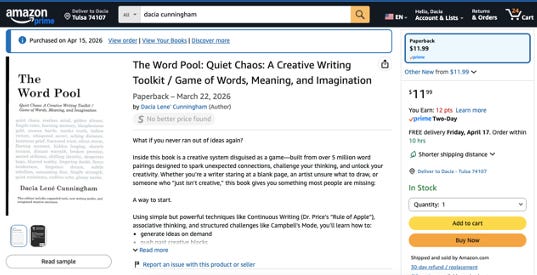
Quiet Chaos: A Creative Writing Toolkit / Game of Words, Meaning, & Imagination! Creative Writing Prompts.
To say that I am excited is an understatement.
I am BEYOND excited. This is not my first publication; I’ve had several short stories and three novels published, along with a children’s book, and a coloring book that my daughter illustrated … but THIS book. Y’all. I can’t. I am happy, happy, happy, and I think every writer and artist should have a copy of this book on their desk – not the shelf because this book will be used!
It is a collection of 1800 nouns, 3000 adjectives, and 1000 verbs. There are multiple sets of ideas/instructions on how to use it, both individually and in classroom environments, with examples in use and testimonials from students who have used it to assist with their own writing. There are MILLIONS of possibilities for creative writing prompts and sketching in this book. Random pairings.
Stuck? Can’t find the right adjective? This book can help.
Don’t know what to write about? This book has the idea for you.
Need a fun game that everyone is sure to enjoy? Here you go!
The book begins with “Why This Book Exists,” where I explain exactly how this collection came about and why. Then, there, as stated above, are multiple possible ways to use the contents, the curated collections of nouns, adjectives, and verbs, in surprising and fantastically creative ways. This book is for writers, artists, students, teachers, and anyone who is bored, anyone who can’t find just that right word. This book has your back. Period.
The buzzword in politics is “Clear.” Both sides say it, and as soon as it comes out of a politician’s mouth, I distrust them; I’m going to side-eye that individual from those words forward. It disappoints me. If you have actually researched and your argument stands on its own, there is no necessity for the words, “Let me be clear.” They’re rhetoric. Pretty words. A veil. A covering. It’s like liars who use the word “Honestly” to ensure you believe something they’re going to say. My response? How about no. If you’re a truth teller, you don’t need to qualify anything you say with “Honestly” or “Let me be clear.” Those words are rhetoric – words chosen with the intent to persuade a reader/listener. The actual definition, according to the Google Dictionary/Oxford Language, is “the art of effective or persuasive speaking or writing, especially the use of figures of speech and other compositional techniques.” The ART of using words to persuade. Rhetoric is fun and effective to use if you’re a politician because, well, most people do not think for themselves. We are like sheep joining a sheep circle, going round and round and round, just following whoever looks and sounds like the leader. Hence the term “wolf in sheep’s clothing.”
“Let me be clear” is telling the listener to believe what you’re going to say – that you’ve done all the research necessary and you are trustworthy. What you say is clear and accurate. There is no need for a listener to question the authority of your words. You are clear. There is an element of imposed guilt on a listener if they dare to question the statement made by the individual who says it is “oh so clear.” That is in quotation marks, so you read it in my sarcastic tone. “Let me be clear” is an excellent tactic on many people, which is why it is used so often nowadays in politics and in the media. Listen for it. Start counting the number of times you hear it. Make it a drinking game when you watch the “news” (sarcasm again – they’re not reporters now, they’re commentators/opinion givers) if you’re not an alcoholic.
I tell my students to be aware of rhetoric – understand it. Recognize when it’s used on you. Know how to effectively use it on others if you so choose. Law. Politics. Sales. Media. These career fields exist on the back of strong rhetoric. Persuasion is the euphemism. Manipulation is the curse word. Rhetoric.
One of my major teaching points in Comp I is Stephen King’s brilliant, rhetorical move in the short story “The Man Who Loved Flowers.” My favorite paragraph in that piece is this:
“The radio poured out bad news that no one listened to: a hammer murderer was still on the loose; JFK had declared that the situation in a little Asian country called Vietnam would bear watching; an unidentified woman had been pulled from the East River; a grand jury had failed to indict a crime overlord in the current city administration’s war on heroin; the Russians had exploded a nuclear device. None of it seemed real, none of it seemed to matter. The air was soft and sweet. Two men with beer bellies stood outside a bakery, pitching nickels and ribbing each other. Spring trembled on the edge of summer, and in the city, summer is the season of dreams.”
“The radio poured out bad news that no one listened to:” is the opening line of the foreshadowing paragraph. In this paragraph, King tells the audience what the situation is, but it is sandwiched between “Don’t listen to this” and “None of it seemed real, none of it seemed to matter.” None of what King just had the radio say matters. Don’t listen to it. It’s not real. It doesn’t matter. And then, the air is soft and sweet. People are kidding around. And summer is the season of dreams. King effectively told the significant plot point but hid it inside rhetoric. “Don’t listen” and “It doesn’t matter.” And the reader falls for it. The reader doesn’t remember that a hammer murderer is on the loose. And that is the truth of the short story. There is a hammer murderer, and as the reader, you already met him, but you don’t know it. A reader in 1969 would have had further complications in pointing out the foreshadowing because each of the items that follow “a hammer murderer is on the loose” are actual things happening in May of 1963, in New York City news. That audience would be red-herring distracted from the hammer murderer. A rhetorical move well done. Well done. Personally, I find this paragraph of King’s to be brilliant rhetoric. Beautiful, actually.
I can appreciate rhetoric; I find it useful in the classroom, but I do not use it as a weapon. I use it to engage my students, to open minds to new ideas. I do not use it to manipulate or trick them. When I see that happening in media and in politics (and in sales – like car sales – my least favorite shopping venture), it grates on my ever-loving last nerve. “Let me be clear” … I think not. No, thank you. If you had anything of actual value to say, you would have no need to use a subversive, fad-driven, rhetorical device/buzzword.
Remember when someone on the news said J.D. Vance was “weird” – and within days, every station was using that same rhetoric-driven buzzword. The fad began, and people watching those particular news shows believed the word. Thus, J.D. Vance was indeedweird – declared by not only news stations and politicians but also SOCIAL MEDIA – and we all know that social media is reliable for information gleaning (again, sarcasm by me – I hope you do know to sift through anything you read on social media. It’s a rhetorical minefield). Social media, where information is validated because “everyone” says it. LOL … oh man. Seriously. Maybe it’s not that J.D. Vance is “weird,” it might just be that he is different from you – maybe he has a message that someone does not want you to hear or believe. So, rhetoric is employed, and he is called “weird,” so that the masses of people who easily follow and believe what the media tells them will distrust him. Please stop and think. If we are going to play that rhetorical game, J.D. Vance probably thinks that the individuals calling him weird are “weird.” Geez, people. Think for yourselves. Don’t fall for rhetorical terms tossed out by people who want to invalidate another individual – and we just let it happen. It’s far too easy for those skilled in the art of rhetoric.
“I can’t write,” “I hate to write,” “I’m not a good writer,” “I don’t know what to write,” “Writing is hard.” These are all phrases I hear from students and people out and about in the world I bumble around inside, especially when those folks discover my occupation. “Oh, you’re an English Professor; I better clean up the way I talk,” or “I’d do terrible in that class; I can’t write,” they say apologetically and with much insecurity. Without fail, I say, “Oh please, anyone can be a writer, and if you took my class, I’d prove it to you.”
Anyone can be a writer. I believe that. In “On Writing,” Stephen King said, “Take any noun, put it with any verb, and you have a sentence. It never fails. Rocks explode. Jane transmits. Mountains float.” Wa-la, you’re writing. At its core, it’s not that complicated. You have thoughts. Write them down. Do you have more thoughts? Write those down too. You have no thoughts? Write that down. Write whatever is in your head. Write about having nothing in your head. I’m getting ahead of myself. Most folks, when told it’s time to write, absolutely freeze. Freeze or internally weep. Our problem is that somewhere along the way, someone said something that caused you to feel inadequate. And that inadequacy turned into the lies we tell ourselves about ourselves in the form of “I can’t,” which becomes “I won’t.”
I address this in my classes by talking about Word Vomit. As I talk about letting whatever is in your mind and your heart flood the page, a baby spews on the presentation screen behind me. The visual “helps” the students get this idea of word vomit into their heads. Spill yourself onto the paper before you or the keyboard in front of you, whichever it is. They’ll never forget that baby! Chuck Wendig, a writer and blogger I enjoy, calls it, in his article “25 of My Personal Rules for Writing and Telling Stories,” “Bleeding on the Page.” When I discuss his angle on continuous writing with the students, there’s a bloody spill on the screen behind me; in his article, he says to cut yourself open and color your words with your heartsblood! Here, he says it best:
“Don’t write purely to escape pain and fear. Mine it. Extract those wretched little nuggets of hard black hate-coal and use them to fuel the writing of a scene, a chapter, maybe the whole goddamn book. Cut yourself open. Color the words with your heartsblood. I am an advocate of finding the things you fear and opening old wounds to let them splash onto the characters and inform the tale at hand. We’ll know. We’ll feel it, too. This is where your experience matters — it’s not necessarily in the nitty-gritty of mechanical experience but rather in the authenticity of your emotional life. And this is true for the opposite, as well — write about the things that thrill you, that stir hope, that deliver unto you paroxysms of tingly exultation. Be true to yourself and we’ll all grok your lingo, Daddy-O.”
Bleed on the page. Word Vomit. Imagery does wonders for belief. Any of us can pour ourselves out in freewriting—absolutely anyone. My friend, Dr. Douglas Price – the Director of Faculty Development and Global Learning at Tulsa Community College- has recently developed a tool for continuous writing that he and another friend of mine, Professor Amy Rains, are fine-tuning and collecting data on. They received a DaVinci Institute award for their work this past year. Since then, I have gleefully welcomed Dr. Price to my classrooms to share his insights and incredible tool, which assists students in continuous writing – and beyond that, continuous thought.
The practice is continuous writing, without stopping, just letting words and thoughts flow. If you get “stuck” in the writing, have a keyword to fall back on and write that word continuously until a new idea pops into your mind, which you will then write and keep going! Something I like to do is write about being stuck, if I get stuck. When I have had “writer’s block,” I’ve written about it—the feelings involved, the frustration, the despair … and then I have some golden, authentic emotions I can give to a character at another time. Writing our authentic internal thoughts is excellent for multiple reasons: it teaches us to keep going, it frees us to stop worrying about what others will think, it shakes us clear of concern about mistakes and editing. Just write. No stopping. Go. Go. Go. Get it out. Write without stopping; we practice this in freewriting, rough draft writing, journaling, anywhere you need to get words from your head onto a page.
Dr. Price visited my classrooms this week, and we, the students and I (because I love to participate along with them), practiced Dr. Price’s tool for continuous writing. During this visit, he specifically had us focus on comparisons. Take two words that have nothing to do with one another and see where your mind takes you as you continuously write. No stopping, just writing, and if you get stuck, write about it, or use a keyword to repeat until a new thought appears.
What follows are my freewriting examples from our exercises. I’m pleased with the results, as were the students pleased with their own. All of these students, who weeks ago, before my class, and the words from King, Wendig, and me, along with Dr. Price’s two visits to the classroom, used to say, “I can’t,” which meant, “I won’t.” Now … they can, and they have, and they will.
Nametag & Parachute
They found it on the ground, not far from the parachute. Her nametag. It lay in the mud, surrounded by remnants of this and that, things unmentionable due to the tragedy of the accident. The parachute had not opened … and she plummeted to her death. The newspaper would tell all the details, but for now, standing in the midst of it, the coroner just stared at the nametag. Chelsea. Her name was Chelsea Street. A young woman, it appeared. Probably full of life and laughter, excited to jump from a plane for the first time. Or maybe she was an expert and had done this many times, only this time, the chute did not open. Time would reveal that information to the CSI team, but the coroner’s job at this moment was to observe the body, so she took her attention from the nametag which was an embroidered piece of fabric that still semi-clung to the jacket that lay a few feet from where Chelsea’s body lay indented into the ground.
“Sandy, take a look at this,” said a young man crouched near the body. His name was Dan, and he was her newest assistant. Most didn’t stay with her long; she didn’t understand why, but she had come to accept the revolving door.
Sandy stepped closer to the body, and she looked down at the woman whose life had tragically ended that morning. How did this happen, Chelsea? Did the chute not open as it should? She waited and, before long, Chelsea spoke to her only in a voice no one could hear but her. “I didn’t open it.” The coroner heard the words, let them sink in a moment, and asked, “You did this on purpose?” Chelsea replied, “Yes.” And Sandy knew the CSI would find no flaws in the chute.
Snail & Dumpster
It was a long way to the top, but Herbert kept going. He knew the ‘promised land’ would await him once he reached the top. He had heard about the inside of the giant thing from some flies that he knew, though his parents told him not to associate with the flies. They were bad seeds, his dad said. But Herbie wanted to find out what was on the other side, or even better, on the inside of the giant thing. One of the flies had called it a dumpster; Herbie had seen it plenty of times but never knew its name. It was unmentionable. Something his parents ignored, even though it was larger than life.
Stick to the rocks. Stick to the shoreline. Don’t go on the concrete. Don’t go where the people go. Stay safe. Herbie didn’t want to play it safely. He tried to “LIVE.” You know, like the flies. He wished he had wings instead of this shell. Being a snail restrained him. He didn’t like carrying around the weight of his room all day, every day. He wanted to sprout wings and be a fly, though he heard that snails lived longer than flies, so there was that. But heck, even in their short lives, they got to see things that snails never did … and so, that morning, Herbert had kissed his mother and told her he was going to snail school, only he didn’t go. He made his way to the concrete and slowly took his first slide onto the hard surface, not knowing how it would feel. It wasn’t so bad, so he kept going, and before long, though the sun had fully changed positions, he looked up and saw the giant dumpster before him. It was even bigger up close, and his heart swelled with excitement. At the top, he saw flies flying around, doing what they do, and he tried calling out, “Hey, guys! Hey, flies!” But no one heard him, so he found a spot where he could begin his climb, and Herbie began edging upward. So far. At some point, a fly noticed him and whizzed past him …
Cauliflower & Guitar
He strummed the guitar no more than five feet from me. The music was soft, and I was sleepy. I needed to wake up. Something, anything. And then, my food arrived. So grateful for something to do – you know, feed my face. And … there was cauliflower on my plate next to my steak. I did not order cauliflower. Gross. It’s one of the nastiest substances on this planet; I will not eat it. But I don’t want to cause a scene. This place is quiet except for the lullaby floating around in the space from that man’s infernal guitar. He plays on and on, and I think this concert is for senior citizens.
Looking around, no, there aren’t any of those here, but I seem to be the only person squirming in my seat because the music is so dull! My husband seems content with the food on his plate. His steak and broccoli sit there ready to become one with him, as they usually do when he orders them. It’s a routine, and he is happy. But they gave me cauliflower. Ugh. I can’t eat it anyway – even if I wanted to. Which I don’t. So … what to do with it? Everyone is distracted here. No one is paying attention to me. I wonder … I could break the cauliflower into little pieces and try to toss it inside the guitar. He’s only 5 feet away … I bet I could make it. I’m a basketball player after all. Naturally, I will think of making a basket!
Boat & Cello
My favorite piece of music is “The River Flows in You” – especially when done by Hauser, a member of the group 2 Cellos. His video for “The River Flowers in You” is filmed in a boat on a river, and he beautifully plays the melody on his cello. It is mournful, almost, and the setting sweeps me into emotional flow every time I hear it. It seeps into every fiber of my being, and I am on that river, not with Hauser, but alone … I am there, and I am sad, and I am content. I am hopeful, and I am relaxed, and I am mourning … so many things all wrapped up as the music soars through me and the water gently moves me along. They work in tandem with one another – I lie back in the boat and float on a sea of emotion, but gentle emotion, taking me to a place of serenity where I can be open and free and not have worries or concerns. It is a release, and I long for that at all times. I will play “The River Flows in You” with intent from time to time because I need that music. I need that song … in cello, and I remember the river. I am in that boat, and Hauser plays the melody, and I drift … drifting, drifting … ever down the river of emotion but gentle emotion, soft and sweet, though a tint of mournfulness because Life is serious … Life is to be lived and we are to rest and we are to exult and we are to be in the moment, and in this moment, I am all of those things. I want to be in this boat …
Curtain & Trees
She pulled back the curtains to let in the day. The morning light spilled in and lit the room. Her eyes adjusted, and she flipped the latch to unlock the window. She heaved because the window was heavy and opened it, allowing the fresh morning air to rush into her bedroom. Ahhhhhh. The morning. There is nothing like morning. Nothing smells like morning. Especially here in the mountains. She smiled and looked out of the window at the forest surrounding her cabin. The mountain rose in the distance beyond the trees, and a few hawks circled above it all. She wanted to be nowhere but right here. A day lay ahead of her where she would play in the sunshine, wander through the trees, explore the base of the mountain, and perhaps skip rocks on the river. No pressure. No worries. No concerns. No sounds just birds, water trickling, and a car’s tires on gravel … Wait, that’s not the sound she should hear. The sound grew louder, and a car came into view – coming down the gravel drive set between dark rows of trees that overhung the simple road. It was her grandfather’s truck, and she wasn’t ready for his bellowing. Maybe she could pretend to be asleep. He’d get what he needed and leave. She pulled the curtains closed a bit and hid behind one of them, hoping he hadn’t seen her in the window. She was not in the mood to listen to any of his stories or help him hunt for this or for that that he left in the kitchen or the garage. It was always something. At those thoughts, she chided herself. He meant well. He always meant well. It wasn’t his fault that he had no volume level other than loud. Bless his heart. He’s hard of hearing … she pulled herself together, slipped on her flip-flops …
Mirror & Trains
She glanced in the mirror and adjusted her hair. A few strands were loosened from the wind outside near the train stop. She wanted to be presentable. No, she needed to be presentable. It has been two years since she last saw him. How has time flown like that? It is cruel, time. She saw the lines in her face were deeper, and she hoped he wouldn’t notice. She hoped that when he saw her, his eyes would light up and time would disappear. She kept looking at herself in the mirror and wondered how life had brought them to this space – to be so distant but love so hard. It was also cruel. Life. The mirror. All of it. He had to take a train. Trains make so many stops, and the time stretches far beyond what a plane ride would take. Even what a car would produce. And so, it was the train, and time is cruel. She wiped a piece of loose mascara from near her eye and took a deep breath. Two years. Okay. You can do this. Her heart raced. Her hands were a bundle of nerves. She hoped he was just as anxious to see her, but she also didn’t wish feeling this anxiety on him, hoping he was happy and on an adventure. Who knows what they would do with their time? She hadn’t made a plan. She wanted whatever time they had together to be spontaneous. She left the restroom and made her way to the train platform outside, again in the wind, and the strands of hair she had corrected chose their own freedom and flew with wild abandonment in the air. The train whistle sounded, and she stared down the track … hoping this was his train! But another train whizzed past. Not stopping. Ah, the anxiety. And then, another train came into view … and she prayed this was the one. It was time. It was time, ten minutes ago, but that time is cruel … and so, she waited. She watched, and the train came to a stop. Passengers filed off, and she strained to see him. Desperate to see him, but he wasn’t there. Where was he? Person after person filed past her, and her heart sank. Maybe he had decided not to come. He didn’t want to see her after all. Her hopes dashed, but she understood. She understood that he hadn’t desired to prioritize her in his life after she had left all those years ago.
Why would he? She understood. She crossed her arms, rubbed her hands against her skin, and sighed. Deeply. No one else remained to come off the train, and she turned to walk back into the sanctuary of the bustling train station, where she could disappear into the people and not be noticed in her sorrow and shame. Out in the air, on the platform, she felt a neon sign flashing above her saying, “Look at that mother who left her son years ago! She doesn’t deserve his love!” But you don’t know my story, she wanted to shout back at the sign and the people and the air.


 Lenazy's Life