Creative writing from the classroom and beyond. Home of The Word Pool Method — a simple, powerful way to spark stories using unexpected word pairings. ✍️ Each week: new prompts, short pieces, and writing challenges.
Thank you to Miles Rogoish (www.mrface.art and/or IG: @milesrogoish) for the beautiful artwork for the book! “Shifting Identity” was the perfect art prompt for Miles. He recently discovered an appreciation for coffee, and this piece depicts that … his identity shifting!
The new edition on Amazon includes more artwork and short stories all drawn from the prompts in this book.
Our son, Joey, wrote a piece with the prompt, “Agonizing System.” It blew my mind!
A current student wrote a horror piece using “Campbell’s Mode” as an assignment in Comp I. I enjoyed it so much, I asked her if I could include it in the book!
There are millions of prompt possibilities in this book! And, there’s excellent information on continuous writing for those who claim writer’s block from time to time … and for those who don’t.
I’m pleased with this project, and I use it myself.
“The Word Pool” has MILLIONS of Writing and Sketching Prompts. Don’t Believe Me? Read This. Today’s Prompt? OPPOSITE STUDENT DIFFERENTIATES. WTH?!?! Right? Nope. My Brain Had This.
Inside this book is a creative system disguised as a game—built from over 5 million word pairings designed to spark unexpected connections, challenge your thinking, and unlock your creativity. Whether you’re a writer staring at a blank page, an artist unsure what to draw, or someone who “just isn’t creative,” this book gives you something most people are missing: A way to start.
Using simple but powerful techniques like Continuous Writing (Dr. Price’s “Rule of Apple”), associative thinking, and structured challenges like Campbell’s Mode, you’ll learn how to:
generate ideas on demand
push past creative blocks
connect unlikely concepts into stories, characters, and visual scenes
build confidence in your creative voice
This isn’t just a writing book. It’s a tool for teachers, students, writers, artists, and creators of all kinds.
Open the book.
Pick two words. Or three.
Write it. Sketch it.
Let’s go.
Here’s an example of exactly how to use “The Word Pool.”
Randomly, I’ve chosen “Student,” “Opposite,” and “Differentiate.” Now, a verb isn’t always necessary. Most of the time, I begin with simply an adjective and a noun. Recently, I had my Comp I students write a short story with 4 out of 6 adjective/noun combos from “The Word Pool.” Their combos were: Noxious Room, Incessant Secret, Fortunate Painting, Faux Email, Disloyal Blood, and Approaching Lantern. They chose 4 of these 6, which I had randomly chosen from “The Word Pool.” Their stories were AMAZING, verging on King-worthy creepy horror stories! I was thrilled to say the least, and enjoyed reading each one of them. Those students didn’t have those stories in their heads BEFORE the word combinations came their way … the word combinations sparked the ideas! This book gives birth and gives life to creativity! So, let’s get back to … “Opposite Student Differentiate!”
I’m going to set a timer for 10 minutes and see where my mind goes. I have no plan. Literally, I opened the book a bit ago, chose words at random by looking away as I flipped pages, pointing to a spot on the page at random, and then looking at where I landed. So, here we go.
The light came in through the window as she sat staring off into the distance. To an outsider, it looked as if she were pondering which book to pull off the grand bookshelf, but that’s not what reality was in that moment. She hurt inside. She didn’t think she could pull it off, and everyone kept telling her she’d be fine; she could do it. But, she knew she couldn’t. She knew that she’d fail. She knew she was the opposite of what a student ought to be. She didn’t want to acquiesce to anyone else’s way of doing the things before her. She liked to live by the seat of her pants, be carefree, but they wanted to put her in a box … and she let them. Traveling. Disappearing. Hiking. Exploring. Go. Go. Go. That is what she wanted. She wanted to learn from life – meet people in strange places, delve into their cultures, experience humanity and landscapes, and all the beautiful things. But no, here she was in the great library, surrounded by books, the light from the outside pouring in through the window taunting her, telling her all that she was missing out on by being stuck in that space.
Learn all the things – learn the business.
It will be yours soon.
You have to study.
That’s what her grandfather said. He wanted to leave it all to her, and she didn’t want it. The whole family said their future rested on her shoulders, and she wanted to burst out of her skin. They all saw no other future for her, but she sat there knowing that she, the opposite student, differentiated between freedom and a state of giving up – and in that moment, as she sat staring at the bookshelf, lost in thought, looking like she was doing as expected, the escape plan began to shape in her mind. She had to leave, run, fly. Anywhere but here. They’d figure out how to pick up the pieces without her. She needed the sand between her toes, eagles soaring high above her, snowflakes hitting her face – so many wonderful places and so little time, and she would not waste a moment. No. Not me, she thought. I will be free.
“Mary Ann, your grandfather wants a word.” The voice snapped her out of her plan.
She looked toward the voice, and there stood her grandfather’s solicitor in his crisp three-piece suit. It was black, and it made him look like a funeral home director. For her, that’s what he felt like, and she simply nodded understanding. She looked out the window where her freedom lay, just briefly. She sighed, then looked at the solicitor’s unsmiling face. Quietly, she followed him out of her grandfather’s grand library and down the hall to the dining room, where she knew, at this time of day, her grandfather was having his fifth cup of coffee …
I don’t know Mary Ann, and I don’t know why she doesn’t want to run the family business, and I certainly do not know where that’s coming from inside me. We could have a psychology session, I suppose, and sit and dissect how Mary Ann represents a part of my psyche, and that could be fun, but that’s not the point. The point is, without the prompt “Opposite Student Differentiate,” that story would never have surfaced from my mind.
Sometimes my posts are non-fiction. Once I choose my word pairing, I sit down, open the laptop, and words just start spilling. If I “get stuck,” I employ my friend Doug’s continuous writing method (which is discussed in “The Word Pool” book) … apple, apple, apple, I just got a text from my son. He said something about eating breakfast. Wish I could be eating it with him. I hate the distance between us. And then, when I’m ready to get back on task … get back on task. Words can be edited. Rearranged. Changed. Just keep writing. Beautiful things come when we stop trying to control them.
Ah … that’s a lesson for life, too, is it not? Beautiful things come when we stop trying to control them. That’s bumper sticker stuff!
Long story short here … use “The Word Pool” to spark your creativity. It’s fun, and you never know where it will take you! Every time you sit down to write, something NEW happens. Or when you need an idea to draw … it’s in this book.
My student, Izabel Baker, permitted me to share the short story she wrote for Comp I. The assignment was to take 4 of the 6 “The Word Pool” word pairings and freewrite – let the words take you wherever they want. Those pairings again were: Noxious Room, Incessant Secret, Fortunate Painting, Faux Email, Disloyal Blood, and Approaching Lantern. Here is Izabel’s story. See if you can find the word pairings.
Why? Why did I pick up the phone? Why did I listen? Why did I come here? Why? Why, after all these years, these long ten years, why?
Every morning, all the same, I awoke, I made breakfast, the phone rang, all the same. I ignored it, all the same, like every morning. It would pass, the tone would end, and it would be gone. I went on with my day. I got dressed, got my shoes, and got my keys. Then, unlike every other morning, the phone rang again.
That was wrong. It never rings twice; it only rings once. It couldn’t ring twice, no, no. There was no one to call twice; they were gone by this time. Every morning, they made the phone call and shortly after were gone forever. How could they call again? But all the same, I ignored it, as I should. Answering would be a grave mistake, grave indeed.
I left, left the house, left the phone behind, there, couldn’t answer it now. It couldn’t reach me now. I’ve moved one, moved one from that, left it behind me, gone forever—no point in answering.
Then I returned home, the phone was ringing when I arrived, and it rang all night; it didn’t stop. Finally, I couldn’t take it, that droning noise, piercing my skull, rattling my bones. I made a grave mistake, I picked up the phone, and I answered it.
“Sadie, are you coming home? We found your bed empty this morning. Mom’s really worried about you. We all are. I- I really need you, Sadie. Please, your little sister really wants you to come home. Please, Dad’s really mad, Mom’s just crying in the kitchen. Sadie, please come home.”
She sounded so real, so alive, so vivid, so visceral. I couldn’t. The sound of her voice chilled me, froze me. So why? Why did I listen? Why did I return?
The house emerged from the ground, surrounded by open fields. There were a few cows out there, what few could survive without human aid on just the grass that grew. I stared at it for a long time; that thing loomed over the road. Why didn’t I turn back then? All I would’ve had to do was turn the key and drive away, but something pulled on me.
Then I saw it and saw her. A young girl standing on the porch, holding a lantern, a small, dim lantern close to her chest. She was almost hiding it from me, like she didn’t want me to take it. It wasn’t Tammy, no, Tammy was only twelve years old; that girl was much taller, older, something about her felt a little familiar, though.
I got out of my car, and she turned into the house, but she left the door open. It was dark inside, and I could barely see in. I couldn’t decide how I felt. I felt repulsed, my mind told me to run, to leave, but deep inside of me, I felt compelled to enter. Maybe that’s what they call a soul; maybe it was calling for me inside. Left behind when I left here ten years ago. Now that I think about it, it was exactly ten years ago that I got the first phone call.
Every day for ten years, the phone rang every morning at 7:34, every morning since.
I took one step inside, then another, then another, then another, then the door slammed behind me. When I turned to open it, it was locked. I couldn’t leave. I never should have come in here. Why, why don’t I listen to my gut?
Then there she was again, past the foyer, at the end of the long hallway, that girl, but she was closer than before now, and her lantern was held so tightly; she held it just in front of her chest. I went down the hall toward her; dust floated in the air, the wallpaper was peeling, the floorboards creaked, bugs crawled this way and that. The water and termite damage had gone long untreated, ten years untreated.
When I looked up, she was gone, but to my left, there was a door. A faint light came from within; I turned inside. The study. I never came in here. Dad would yell if I ever did, but yelling was all he ever did. A lamp flickered in the corner, the books on the shelves were sloppily thrown in, and the old computer was covered in dust. I doubt the keyboard even worked, not that I cared to see what he had been doing on it, just when he was on it. He was occupied then, in his own room of the house, for just a few moments, I could forget about him.
On the wall, there was a painting. What a fortunate painting it was. All of us, mom, dad, me, and my little sister, all smiling. It didn’t see the real us; it saw the nicely kept home, not the stains and messes. It saw a happy family, not the horrors left by our father. It saw an able-bodied woman, not a mother whose health declined further every day.
Tammy, you bright little girl, you had the biggest smile. I like to believe a little bit of it was real. You were always so positive. I did my best to keep you safe so that you could keep smiling. I’m sorry I left, I’m sorry, you probably didn’t smile again, did you?
There she was again, that girl with the lantern; she was standing in the doorway, holding the lantern a little closer to me. She turned away down the hall, but when I got there, she was gone again. There wasn’t a faint light this time; it was darker than before.
There wasn’t any direction; I just wandered for a bit, turning through the halls. The home was larger than I remembered. There was a stairwell; the boards had been chewed through in some places, probably termites, possibly mice. The railing had fallen out in some places and was left in pieces on the floor below. I found myself ascending the stairs, up to the top, then down to the right, a room with an open window; the wind blew the curtain around.
This was Mother’s room.
This was where she looked out, her only window into the outside world. She used to knit blankets, clothes, and tablecloths. Then her health declined; she stopped smiling, stopped knitting, barely moved, only to cook and clean when she could, when the pain wasn’t too much. But it usually was, so I did.
The room hadn’t changed, except for the condition of it; like the rest of the house, the wood was damaged, but even more so up here. I didn’t trust the floorboards; I shouldn’t have. I made my way downstairs, then… the floor gave in.
My heart lurched for a moment; it felt like a moment in a cartoon where the character is suspended in the air for a moment before falling to the ground. But just like in the cartoons, I eventually fell. Unlike in the cartoons, I wasn’t fine and revived after. My breath left me; maybe it was my lungs that had been suspended in the air, not me.
I couldn’t breathe, couldn’t even scream.
I had fallen through the floor onto the dining table, which cracked in two. It felt like my back had done the same, but I managed to get up. A part of me wished I couldn’t so I could lay there and die, but something called for me, not a voice but a feeling. She was closer than ever before, that girl, her lantern stretched out towards me, almost a full arm’s length. For the first time, her mouth moved, and she spoke, “Remember, remember what you did. Those splats of blood, that disloyal blood. Remember why you left, why you abandoned everyone.”
I looked beside me. There were drops of blood on the table where I had fallen, bits of wood had scratched into my skin, leaving gashes. I tried to wipe it away, but it smeared across my arm. I burned everywhere: the bruising on my back, the cuts on my sides, but I had to keep moving.
I felt bits of resentment towards that girl with the lantern, forcing me to come here, forcing me to feel this pain, forcing me to relive this place, forcing me to remember.
I felt tears come up; they came through gasps of pain and gasps for air. I struggled to move forward on the other side of the door, leading out of the dining room was the kitchen. I went to the wall and slid down it. I didn’t need to know what was on the other side; I could smell it, that thick, pungent odor of blood. There must have been so much on the other side; the wounds must have gone deep. They must have been in so much pain. It was my fault, wasn’t it? If I hadn’t left, I would have stayed. If I had come home sooner, maybe then.
I almost began to sob, but the shaking of my body was so excruciating that I clenched my throat in an attempt to stop it. That noxious room on the other side felt like it was growing larger, more powerful, more gruesome. The longer I waited here by the door, the stronger the smell grew; I heard dripping.
Blood dripping, drop by drop by drop, onto the tile.
I knew I needed to turn the corner. One inch at a time, then another, then another, I peered around the door. I never should have, never should have picked up the phone, never should have listened, never should have come here, never, never. Never should have turned that corner. I never should have left, never should have left Tammy behind. I should have taken her with me, should have gotten help, and done something. But no, no, I left by myself, escaped, I used to say, but no. I didn’t escape this place; I abandoned my sister, my little sister. It was my responsibility to keep her safe, to protect her. I hated my mom, my mom never protected me, never kept me safe, why then, should I for another? Why? Why did I let my resentment for her allow Tammy to get hurt?
She was there, right on the floor. She must have run to the door, tried to escape, but bullets are much faster. Blood soiled her clothes, spilled around her in a pool on the ground. I started to tremble, felt like screaming, felt like running, but I couldn’t. I was frozen, stuck staring at the scene.
Mom lay on the ground, shot straight through the stomach. My eyes followed her to a large metal pot in front of her, to a pair of large boots, and up to a man. I knew who it was, but if I were a stranger coming across the scene, he would have been unidentifiable. His face was gone; the skin seemingly melted off in a spot where his left eye should have been. Large blisters swelled around the area across his neck and arm down to his hand, where a gun still lay. Oil and blood dripped from his face onto the cold tile.
What happened first? Did mom attack him, and then he shot her? Did he shoot Tammy, and Mom throw the pot at him? How? How could something like this happen? Why? If I had stayed, was there something I could have done?
“No point.”
I turned around, there she was again, right behind me, holding her lantern, but still far away enough that I couldn’t quite make out her features.
“No point in asking questions, you know what must be done. Now go, do it.”
She didn’t sound sympathetic; I wouldn’t either. Who else was there to blame myself? But I knew what she meant. I knew what must be done. I went to the back door and found it unlocked. I dug three holes, took what felt like hours, but the sun wasn’t even considering rising yet. I went inside the house, for a moment I considered leaving my father there, but in the end decided he ought to be placed in the ground anyway, it wouldn’t be fair for my mother and Tammy to be laid below our father.
I couldn’t fashion a true gravestone, not now at least, but I found old scrap wood and a knife from the kitchen and scratched into it plates for my mother and Tammy. “Here Lies Tamala R. Julias. May 2, 2004 – April 10, 2016. Rest in peace, Bright Child.”
I didn’t make one for my father; he ought to be buried, not honored or respected.
I stood, my work was done, and I saw an approaching lantern. The girl came all the way to me. This time, she was close enough for me to make out her features, my own features. She was fifteen years old, with a bruise on her arm, sullen cheeks, and so much shame.
Maybe, maybe I ought to forgive myself, or rather, forgive her.
She was only fifteen, I was only fifteen then, the past is behind me. I can only move forward. That old version of myself, a ghost, a memory, whatever the vision was in front of me, handed me the lantern. It felt nice, expelling some sphere of warmth around it. I looked at fifteen-year-old-me, “You poor thing, please, please move on, I forgive you.”
With that, a smile, albeit a painful one, stretched across her cheeks, and she faded away. I was alone now, but then again, I had been alone for many, many years.
Tammy would forever be gone, but I found a new part of myself.
Life wasn’t over, mine wasn’t. Tammy would probably tell me I should keep on living.
I found a picture of Tammy, Mom, and me, one of the few that was just the three of us. I decided to keep it; every night on my bedside table, I told them goodnight, and maybe beyond the veil, if there is one, they said it back.
Dacia Lené Cunningham is an Assistant Professor of English at Tulsa Community College, where she blends creative writing with real-world communication in courses ranging from Novel Writing to Composition.
She is the author of novels, short stories, and children’s books, including A Kiss in the Rain and The American Queen, and she founded the TCC Writers’ Series to bring authors and publishing professionals directly to her students. https://guides.library.tulsacc.edu/TCCwritersseries
She believes anyone can write—you just need the right tools.
The Word Pool” is a beautifully written book devoted to writers who love to play with language. The idea of pairing unrelated adjectives and nouns together to impregnate them with new meaning makes for unforgettable writing, Thomas Paine wrote about the “summer soldier and the sunshine patriot.” His purpose was to steel the resolve of the American Army in the face of overwhelming British military power. His use of words was unforgettable, inspiring Americans for 250 years.
“The Word Pool” gives writers the tool to match unlikely words together to create new meaning. Complete with exercises and examples, this work is pure genius. It is a “must have” for every writer’s library.
New review of my creative writing prompt book, “The Word Pool,” from Forest Issac Jones, author of ‘Good Trouble: The Selma, Alabama and Derry, Northern Ireland Connection 1963-1972.’
“Students of writing and writers overall will love this book, and ‘The Word Pool’ will be widely recommended by teachers of writing. It is a true example of what a creative writing tool kit should be. The authors leave you with tidbits that will spark ideas and great examples of writing prompts. This book is full of little things that will help writing students. There are great parts in the book that give lists of nouns, adjectives, verbs, and writers are shown phrases and best pairings to use. It is a useful book for any writer or student of writing, and it shows the author’s sincere love of language and writing. Highly recommended.” – Forest Issac Jones, Ed. D., Author of ‘Good Trouble: The Selma, Alabama and Derry, Northern Ireland Connection 1963-1972’ – forestissacjones.com
Thank you to Dr. Jones for his review!
And, y’all, I’m telling you – this book is fun. I use it – and I wrote it/put it together – and I find it useful! There are so many possibilities. Each Saturday, I’m committed to opening the book with the specific intent of using it here in this space – to show you how it works!
Over the last few weeks, I have opened the adjective and noun pages and find myself using these combinations:
Some of them have caused me to write fiction. Some non-fiction. I just let the words roll out without a plan one in my head.
Tomorrow is Saturday, so we shall see what combination comes! I’m excited!
If you find yourself with a copy of “The Word Pool,” I’d love to hear your thoughts, see what you end up writing or drawing … perhaps I can add your drawing to the next edition of the book!
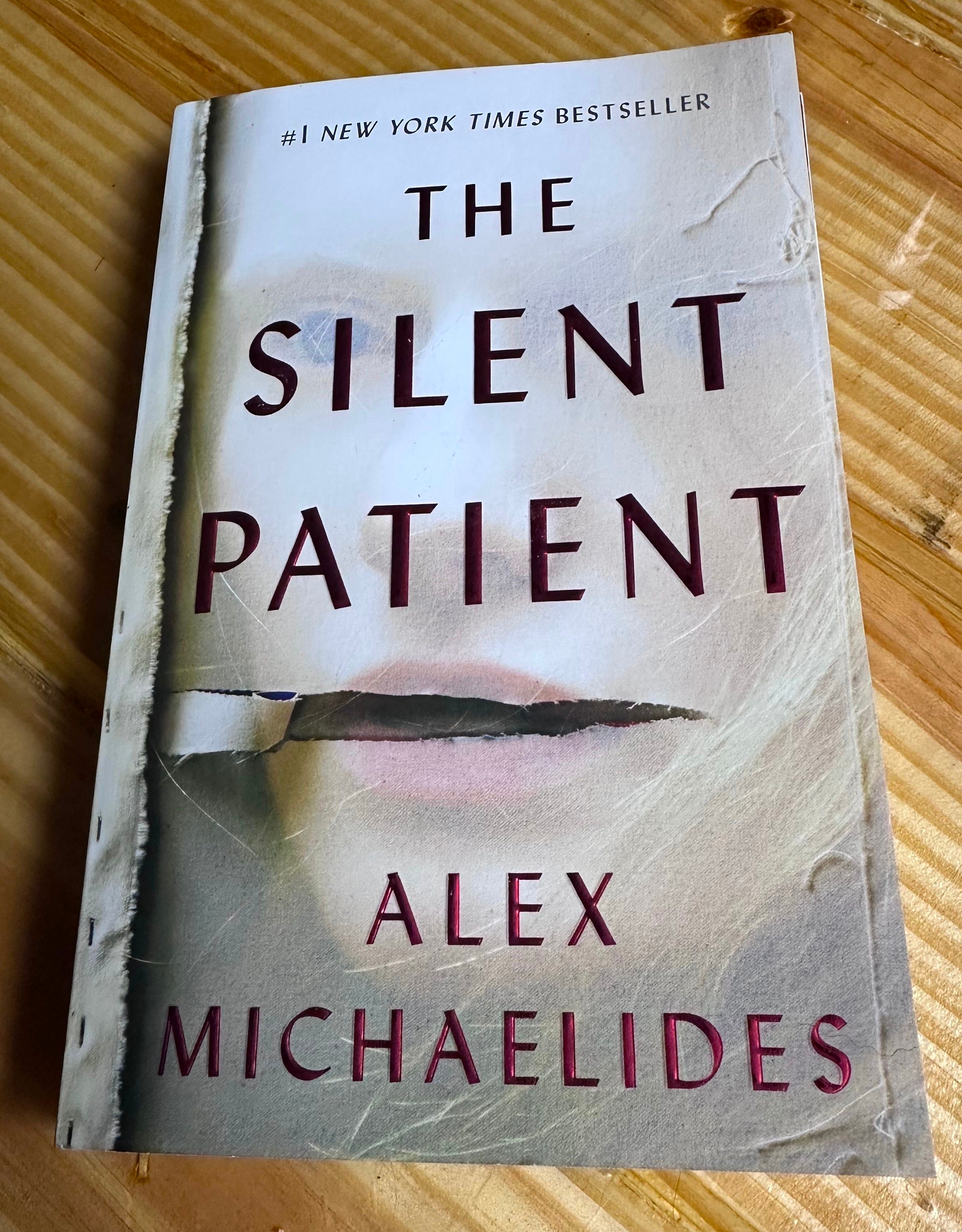
Yesterday, I read this book by Alex Michaelides – the entire book – in about 6 hours. “The Silent Patient” – for me, a page turner.
Before the Spring 2026 semester ended, my “Intro to Literature” students gave book presentations based on the principles we drew from Thomas Foster’s “How to Read Literature Like a Professor.” One young lady, a high school senior, gave her presentation on “The Silent Patient,” which I had never heard of, but by the end of her presentation, I was on Amazon ordering it. Seriously, you know you did a great job on your presentation if your professor orders the book before you’re even done talking! She told just enough in her presentation to grant me curiosity – she didn’t give spoilers – and I needed to find out for myself.
Over a stretch of 6 hours yesterday, I found out why she chose that book for her presentation. Well done, to my student, and well done to Alex Michaelides, the author of “The Silent Patient.” That is what I have to say. How my student was able to give just the right amount of information to cause me curiosity without giving spoilers is incredible to me now on the other side – because as I want to talk about it, I find I only know how to express my actual thoughts WITH spoilers. But I will refrain … what I will do, though, is share a few quotes that grabbed me as I read.
I always read with a pen in my hand – when I do allow myself time to read. See, I read alcoholically – and when I read, no one exists but me IN the book. If you speak to me, I won’t hear you. You aren’t there. I’m gone somewhere. I find that my reading experience doesn’t suit my relationships all the time. If I could be satisfied with reading while he’s sleeping, then no worries, but I become consumed and can do nothing but remain nose to the book until that last page is turned. I don’t mean to. It just happens. I cannot read just one page.
My pen underlined a few passages yesterday.
“I was disconnected from my emotions, like a hand severed from a wrist. I talked about painful memories and suicidal impulses—but couldn’t feel them. I would, however, occasionally look up at Ruth’s face. To my surprise, tears would be collecting in her eyes as she listened. This may seem hard to grasp, but those tears were not hers. They were mine. At the time, I didn’t understand. But that’s how therapy works. A patient delegates his unacceptable feelings to his therapist, and she holds everything he is afraid to feel, and she feels it for him. Then, ever so slowly, she feeds his feelings back to him” (Michaelides 17). The bolded lines are me emphasizing those particular points that grabbed me; they are not a part of the text.
“It’s odd how quickly one adapts to the strange new world of the psychiatric unit. You become increasingly comfortable with madness—and not just the madness of others, but your own. We’re all crazy, I believe, just in different ways” (Michaelides 18).
“Love that doesn’t include honesty doesn’t deserve to be called love” (Michaelides 103).
And then, I was off and running, consumed. No more pen marks, but so much to say. I want to tell you all about it, but I will only say that there is a reason why this book was a New York Times Bestseller. It is well-written, and I enjoyed the dual perspective of the story-telling—from two characters’ perspectives, getting only partial bits and playing the detective on this side of the page, putting pieces together, guessing, second-guessing, and staying awake until well after 1:00 a.m. to turn that last page, my mind racing about the story after that, wanting to tell someone, talk to someone, find a book club about this freakin’ book.
Suffice it to say, it’s a nice way to pass some time—if you’re looking for a book to keep you company for a long Friday evening or a car ride somewhere. This is the book.
And Alex Michaelides is right … “We’re all crazy, I believe, just in different ways” (Michaelides 18). I firmly believe this – and anyone who isn’t a bit off their rocker is suspicious to me. I prefer to be around the ‘crazies’ — they tend to be more comfortable with authenticity … tend to be. Not always … sometimes, crazy is, well, dangerous. And another thing … honesty is essential in life. I’ve learned that through AA, so when I read that particular line, which I quoted above, it resonated with me. “Love that doesn’t include honesty doesn’t deserve to be called love” (Michaelides 103). Most of my life was lived in dishonesty … maybe that’s why I found myself consumed in this book; I understood the characters more than I care to admit. But honesty would have me say that yes, we are all a little crazy, and yes, honesty is the path to a healthy relationship—romantic or friendly—when you truly love another person, you speak truth to and with them, you hide nothing, you work hard at the relationship, and you honor that person, you share with that person through thick and thin, good and bad. Without honesty, it’s a ‘game’ of suspicion and self, a what can I get out of this ordeal, how do I maintain/control/keep life exactly as I want it and perceive it should be? It’s all about me—what I want, what I need. Never is that a solid foundation. Just like characters in this book may (or may not) discover.
This morning, I opened “The Word Pool” to the adjective “Emaciated.” I wanted to choose something different, but no – go with the first one you see. So, I then turned to the nouns, and my finger landed on “Judgment.” I typed those two words on this screen and let my thoughts roll. Here is what came:
Emaciated Judgment
“Can you think of anyone, if you’re honest with yourself, that you don’t have advice for?” Patrick asks this question of alcoholics, and I watch them say, “Yes,” and they’ll want to name a person and defend the response, but then Patrick tells them to get honest …, and as the person reflects over their life, a light comes on – if they’re honest. The truest answer is, “No.” We have advice for every person we encounter – every person but ourselves. And I turn the question inward – “Is there anyone in your life, Dacia, that you don’t have advice for?” Even when I walk through Lowe’s or sit at a table at the Cracker Barrel, I find myself sitting in judgment of most every person I see. If I’m honest, I can and will admit that.
This is especially true of an alcoholic. We believe we are different; we don’t fit. It certainly cannot be anything wrong with us – it must be everyone else, and the blame game is a way of life. If you wouldn’t. If he didn’t. If. If. If. Every other person needs to change in our emaciated judgment. Our alcoholic judgment, which pulls the victim card and waves it high and proud. It’s you; it’s not me. Poor me, and I drink, I shop, I seek attention, I pick up drugs … I’m saying “I” as a stand-in for all alcoholics.
We have an illness of a spiritual, physical, and mental nature. If we straighten out spiritually, the mental and physical straighten out naturally. But this is a hard thing to accept; it is an even harder thing to put into action. Taking steps to sort out the spiritual illness – first admitting it exists and second being willing to get honest about ourselves, our insecurities, our fears, our judgment – this is where the ‘rubber hits the road’ for an alcoholic who desires recovery. It is work.
I see the commercials on TV now for a pill you can take to help you stop drinking. I know alcoholics who take these medications, and hear me, please, these are Band-Aids. They are Big Pharma taking advantage of people who do not want to put in work, who do not want to take the steps, who want to (taking a phrase from the Big Book) rest on their laurels and have their problem solved without any actual change occurring inside. It is too uncomfortable to do the work in AA, which requires the individual to do work on self, to step away from that emaciated judgement I spoke of earlier, into an acceptance of the reality of who he or she is in the scope of life and recognition of the spiritual illness which only a higher power can resolve. The thing about this intense and discomforting work is that the result on the other side, once the steps are taken with willingness and honesty, is well … serenity.
On page 77 of the 12 & 12 (Twelve Steps and Twelve Traditions), it says, “Learning how to live in the greatest peace, partnership, and brotherhood with all men and women, of whatever description, is a moving and fascinating adventure.” We read those words at the dining room table this last week as we sat with a recovering alcoholic going through the steps, and I wrote the words down on a piece of paper. This is a moving and fascinating adventure indeed! The book goes on to say, “Every AA has found that he can make little headway in this new adventure of living until he first backtracks and really makes an accurate and unsparing survey of the human wreckage he has left in his wake.” A little later in the paragraph, it says, “But if a willing start is made, then the great advantages of doing this will so quickly reveal themselves that the pain will be lessened as one obstacle after another melts away.” Ahhhhhh … that’s what the work produces – the melting away of all that keeps an alcoholic sick – those things that are hidden deep inside, that no one knows, that the alcoholic doesn’t even know until the work is done.
When Patrick asks that question, “Can you think of anyone, if you’re honest with yourself, that you don’t have advice for?”, now, on the other side of recovery, I find I still do have advice for most people I encounter, but I’m quickly able to remind myself that most people, in fact, all people, are actors on the stage – we all participate in our own play where we believe we have control, though we are but actors. We want to manage the lights, the scenery, the other players, and the lines people say. We imagine ourselves as the director, but we are not – and we try to assume that role – and we sit in judgment because the other actors do not do what it is that we want them to do, and we find ourselves angry – and some of us take this to an extreme, and we drink over it.
Here I smile – today’s “The Word Pool” choice was emaciated judgment, and this often-had conversation from my dining room table is where that word combo took me immediately. When I sit in judgment of others, forgetting that they are also actors trying to control a show, I feel different, insecure, and my judgment is based on corrupted feelings where my base instincts are affected, afflicted, and I become defensive. I am set apart, and I put myself in a corner with hackles up and ready to fight – though most likely I’ll destroy myself along with everyone I encounter, especially those closest to me. This is not based on healthy, recovered thinking. It is emaciated – withered, shrunken, gaunt … weak judgment. It is a spiritual sickness.
As a recovered alcoholic, I know that apart from staying in fit spiritual condition, my judgment quickly becomes emaciated. I must do the work to stay in connection with my higher power, which for me is the God of the Universe who cares about me so much that He sent His Son into this world to die, to become a sacrifice, the only sacrifice that would suffice to save those who call upon His name. That is my personal belief and understanding based on my reading and research – based on my experience, strength, and hope. I cannot and will not push that (that you must do or believe exactly as I do) on anyone else – on you. Take your own journey to ‘serenity’ – perhaps through a pill – doubtful it will happen truly, but hey, you do you. Or find your own path to a higher power by realizing that you, in your own power, cannot turn emaciated judgment into serenity of heart, mind, soul, and body. You can try, but you’ll drive yourself to the depths of insanity. Step Two in the Big Book says this, “2. Came to believe that a Power greater than ourselves could restore us to sanity.” There’s something to this – and I can preach on it, but at this point, I remind myself that each of us has to truly come to this realization on our own – out of desperation for wholeness – or it doesn’t stick. Do it or don’t. Right?
Patrick also says, after taking people through the steps, “Don’t get mad at me six months down the road, if I make more use of this information than you do.”
Eek.
But he’s not wrong.
So, Dacia, today, where is your judgment at? Is it through the lens of your higher power where you recognize that every person you encounter struggles through this life just like you do, so grace and compassion are a must? Or will I not set my mind right, stay in a state of ‘I’m the one in charge,’ and want to direct every person I encounter to do my bidding and find myself feeling crazy because no one will do what I want?
It is a choice.
“Emaciated Judgment” – The Word Pool Prompt for May 23, 2026.
Using the word pairing, write a sentence, a story, a poem, or draw a sketch, paint a picture. Set your mind free and create. Post it here. Post it there. Post it wherever. Only, please tag it #thewordpool so I can enjoy it with you. Happy creating!
This adjective/noun combo comes to you directly out of “The Word Pool” – I didn’t cheat. I opened the book, took the first adjective I randomly selected with my finger (without looking), and then I turned to the noun section and randomly selected a noun with my finger (again, without looking). Maybe I wanted to choose something different, but no, we go with those FIRST finger-chosen words! Ta-da! It’s that complicated. Now, we write or draw; whichever we do, we create!
“Respected Trunk” – The Word Pool Prompt for May 16, 2026.
Using the word pairing, write a sentence, a story, a poem, or draw a sketch, paint a picture. Set your mind free and create. Post it here. Post it there. Post it wherever. Only, please tag it #thewordpool so I can enjoy it with you. Happy creating!
Respected Trunk – it’s made of cedar wood and holds memories that extend back generations. Christening gowns, her grandmother’s hair, old, cracked photographs of faces from long ago – lives once lived that made her own possible. Old love letters, letters from war, promises made, promises broken, every trinket, every handwritten word a treasure. The respected trunk sits protected in the corner of her room, topped by a crocheted Afghan her grandmother lovingly made of her childhood’s favorite colors – yellow and bright rainbow variegated yarn. Now and then, she ran her fingers over the top of the wood chest to feel closer to the past, knowing its contents, loving each one, praying to be someone who would make her grandmother proud. Oh, how she missed that lady and longed for just one more conversation, one more story, but now, she must settle for the contents of the trunk in the corner, which holds the remains of her grandmother’s life.
This adjective/noun combo comes to you directly out of “The Word Pool” – I didn’t cheat. I opened the book, took the first adjective I randomly selected with my finger (without looking), and then I turned to the noun section and randomly selected a noun with my finger (again, without looking). Maybe I wanted to choose something different, but no, we go with those FIRST finger-chosen words! Ta-da! It’s that complicated. Now, we write or draw; whichever we do, we create!
“Glazed Notion” – The Word Pool Prompt for May 9, 2026.
Using the word pairing, write a sentence, a story, a poem, or draw a sketch, paint a picture. Set your mind free and create. Post it here. Post it there. Post it wherever. Only, please tag it #thewordpool so I can enjoy it with you. Happy creating!
This adjective/noun combo comes to you directly out of “The Word Pool” – I didn’t cheat. I opened the book, took the first adjective I randomly selected with my finger (without looking), and then I turned to the noun section and randomly selected a noun with my finger (again, without looking). Maybe I wanted to choose something different, but no, we go with those FIRST finger-chosen words! Ta-da! It’s that complicated. Now, we write or draw; whichever we do, we create!
Glazed notion … perhaps it is a starry-eyed desire to do something reckless.
He told her she would never amount to anything. He told her she would never find love. He told her no one would put up with her glazed notions about life. He was wrong. Today, she lives a life of love, peace, and coddiwompling! Life is Good!
“Arnold, Shirley Jackson wants me to go against your sexist and evil traditions!”
Sometimes students compose sentences that stop me. I read and reread them with appreciation and silent applause. Sometimes, not so silent. Sometimes, I copy and paste what a student wrote to my own social media bragging FOR them and about them. Proud, proud, proud. Sometimes I read them aloud to my husband and my father because they’re my ‘captive audience’ when I’m grading. (Earlier, I complained about a piece I was grading, and my father, bless his sweet heart, said, ‘You chose this.’ Very reminiscent of my daughter Kennedy’s response when I might feel a bit frustrated about grading. To him, I said, “Okay, Kennedy.” Ha. But, he was right.) This particular copy-pasted piece, however, from a student’s essay, is an entire conclusion paragraph that made me laugh. And because it made me laugh, I must share that laugh with you. So, for anyone who appreciates Shirley Jackson, I present my Comp I student’s concluding paragraph for her rhetorical analysis of “The Lottery.”
“As a story, ‘The Lottery’ is objectively gut-wrenching and horrifying. Why would anyone want to read a story about murder? You want to read a story about murder because it will make you understand that tradition is not always right. When Uncle Arnold shouts at the annual Christmas party, “Little Janie, why are you a plumber? That is a man’s job?,” you can shout back, “Arnold, Shirley Jackson wants me to go against your sexist and evil traditions. She is a critically acclaimed author, by the way!” You might not be named Janie or have an Uncle Arnold, but you do experience evil traditions that “The Lottery” helps you understand. By skillfully using ethos, logos, and pathos, she exposes the dangers of blind conformity and challenges readers to examine the traditions they accept. The story serves as a powerful reminder that just because something has always been done does not mean it should continue.”
If you haven’t read “The Lottery” by Shirley Jackson, do so. Then, read a biography or two about Shirley’s life. Then, read “The Lottery” again. You’ll discover that not only is this author saying not to continue blindly following traditions, but she also is SCREAMING to the reader – “Don’t be trapped!” See, she was a trapped woman. She lived a life of abuse from childhood through her marriage, and her ‘cage’ killed her at the age of 48. Heart disease. It is a scientific fact that stress, anxiety, and fear have a direct correlation to heart disease. Shirley died at age 48. This woman, whose life was plagued with stress, anxiety, and fear, is SCREAMING to the audience, “Don’t be trapped like me!”
This touches me deeply. I was 51 when my heart almost gave out. 51 when I had open-heart surgery … much too young, but that is what a life lived in stress will get you. No more of that in what remains of my days here in this life; each day is an opportunity to share my experience, strength, and hope. Each day I pray, “God, may I be of use to YOU today.” Then, I step into the day, live in the moment, and shine, shine, shine.
I also echo Shirley … “Don’t be trapped!” Think. Explore. Laugh. LIVE. Go against the FLOW. Or, like my student wrote, say, “Arnold, Shirley Jackson wants me to go against your sexist and evil traditions!”
I flippin’ love how the student wove in that Uncle Arnold and Little Janie bit. Hilarious – and powerful. Nicely done, my student. Nicely done.
I can’t. I just can’t with this raising of one’s pitch at the end of sentences; this is called uptalk, and it makes every sentence that comes out of the uptalker’s mouth sound like a question and like the speaker is insecure. It’s like a plague in our society, and I hear it everywhere – mostly in young women in their 30s and younger. The ending of sentence after sentence with a rise in pitch makes the speaker sound unreliable, at best, and insecure, at worst, and I don’t understand how it goes unchecked.
There is a television commercial for Jacuzzi Bath starring Christina of HGTV, and her voice grates on my every last nerve. There is a rise to her pitch at the end of every sentence, and I can assure Jacuzzi Bath that Christina is not their best salesperson – in fact, she probably drives away customers as she sounds unsure, faddish, and well, ridiculous. I show that commercial to my students when we discuss non-verbal arguments.
38% of communication is tone of voice. 38%, people.
Last summer, I took a course through a company I will not name, and the speaker in one of the course videos spoke in uptalk throughout the entire lesson. I could not focus. She was in her 30s, and I’m in my 50s. I’m sure that makes a difference here; however, at the end of the course, we participated in a discussion thread about the materials the woman discussed. I chose to be honest about my inability to focus on the content because of the distracting uptalk, which made the woman sound inefficient, not to mention inexperienced, to lead a course.
Another participant in the discussion thread wrote, “Thank you for saying it!” in response to my direct comment regarding the speaker’s pitch. Others joined in agreement, and it is my hope that the facilitators of the online course will rethink the tone of that content’s delivery, which fell on an audience that values confidence in a speaker’s tone – we were all college-level educators for heaven’s sake.
Just two days ago, I went to a literary launch party … and there it was in a speaker … uptalk. It deeply concerns me that we are somehow teaching younger generations to speak this way. Is it TikTok? Where is it coming from? I don’t use TikTok, so I have no idea. To hear that uptalk at that event from someone who should know better… shocking.
There’s another part of me that wants to refrain from saying anything, say, ‘You do you, Boo,’ and let those who speak with uptalk have at their faddish tones of voice, which make them sound, dare I go ahead and say it? It makes them sound inept, so let’s let them; see, that offers more opportunities to those of us who understand that ending sentences on a lower tone conveys confidence and reliability. So, perhaps … let’s not tell them. But then again, I don’t want to have to continue to listen to it – it hurts my ears and my soul.
In our week discussing nonverbal argument in Comp II (That’s 2, not 11), please know I discuss tone of voice with my students – and I use a variety of sources that are not just me with my Gen X disdain for uptalk, one is Tony Robbins, and another is Vinh Giang (https://youtube.com/shorts/LpGIRhSZ3Jw?si=YC8N6Dp6a3a_aHHA). Each of these, along with other sources – like the Jacuzzi Bath commercial as evidence of what not to do, conveys the importance of tone – your pitch, your pace, your volume, and your timbre. The ability to control and use these in argument is rhetoric in its deepest sense, because 93% of communication is nonverbal (38% tone and 55% body language). My hope is that my students, especially the young women in my classes, grasp the dire necessity of focusing on more than just the words that come out of their mouths or appear on the pages of documents. HOW they are said matters more than what is said. Always.
Rant over. It was on my mind after the event I attended recently, so I needed to speak about it. And I also want to say, as a woman in her 50s who gets this, I am beyond grateful as a mother that neither of my daughters speaks in uptalk – get it, girls! I did something right.


 Lenazy's Life